


Most Boats Have Their Inverters Installed WRONG! PYS Tech Talk
Transcript is auto-generated.
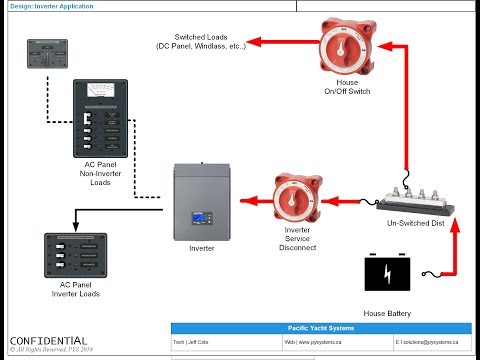
Wondering if the inverter on your boat is properly installed? [music] Check out this video to see the common mistakes on inverter installs. Whether you need a remote consultation design or perhaps inviting us aboard your boat, Pacific Yacht Systems is here to help. Check out the links in the description below. Hey everyone, Jeff Cote here with Pacific Yacht Systems. We've got another installment of Tech Talk. We've got a got a question from a fellow boater. Frank asks, "Hey Jeff, what are the biggest mistakes with installing an inverter?" So, I guess sounds like Frank's going to be installing an inverter on his boat and he wants to sort of know what are the pitfalls. I've geeked out on inverters. I have 1-hour presentations and I've got led many 1-hour presentations just on inverters. Yes, that's right. You can watch an hour-long video on inverters. The devil is always in the details, but let's try to summarize the pitfalls that you might want to look for or look out for when installing an inverter on your boat. Even before describing what the pitfalls are, for some of us it's worth recapping just so we know what an inverter is. An inverter is a device that takes DC power, so battery power, and creates AC. AC power is really the things that we normally would typically associate in our house. It might be a microwave, a blender, a hairdryer. It could even be a heater. So, that's what an inverter is and many of us when we buy an inverter, they also come with the opposite of that, which is a charger, which takes AC and creates DC. So, and that's where the term inverter charger is. So, most of us in our boats are actually going to have inverter chargers, although we're just going to call them inverters, but most of us, like probably 90% plus, are going to actually have inverter chargers, even though we just call them inverters. So, if you're installing an inverter on your boat, one of the biggest mistakes is actually not sizing the inverter to handle all the concurrent loads you're going to have on your boat. So, you've got to ask yourself what am I going to be asking of the inverter and being reasonable, asking how many concurrent loads am I going to have? So, is it going to be a 1,000 W inverter, a 2,000, a 3,000 W, 5,000 W inverter? Most of us are going to probably going to be between 2 and 3,000. And yes, I've seen inverters of 10,000 and some are even higher. But for most, it's going to be 2, 3,000 W is going to be maybe some of us 5,000 W. Of course, outliers always exist. Some of us only have 300 and other ones are going to be 5,000 or 10,000. Look at what your AC loads that are going to be run concurrently, right? So, meaning at the same time. You might want to want to do it all, but there's also a price to doing it all at once. So, run your big large AC appliances. So, that means don't wear a hair dryer at the same time you're running a microwave, same time you're maybe running a kettle, right? Like do them sequentially. And then in terms of the install, you're going to need to make sure that your battery bank can actually sustain that large inverter output, right? So, you can't just install a 5,000 W inverter on two golf cart batteries. The golf cart batteries are going to like the voltage is going to drop and the inverter won't work. So, you need to size the inverter to the battery bank. There's tons of articles and again, on our channel, lots of info on this, but sizing the inverter to the battery bank. And the next thing that is often overlooked, and this is a huge safety device, is making sure that your inverter has what's called a safety disconnect. So, that means you need like your batteries, you need a bread switch so that whenever you're going to be servicing AC on your boat, you're going to be able to disconnect the inverter from power supply, which is your batteries. So, you need what's called a service disconnect. You also want to look and make sure that the wiring is not undersized and all too often, and we see this, where alternators maybe started at 1,000 W and then they got into 2,000 W and now they're 3,000 W. Make sure that the wire size can handle the amperage or the wattage that of the new inverter. So, that's another thing. You want to make sure that your you have the appropriate size fuse on that circuit, and then the fuse is there to protect both the wire and the inverter. Another item that you want to consider is making sure that you actually have the right appropriate size cable as a chassis ground. That's often overlooked altogether because the inverter, like a car, doesn't need a seat belt to work, but in the event of a short or a fault to the case, you definitely want to have a chassis ground. Make sure you've got the temperature sensor connected because if you've got the charger functionality, you want to make sure that your charger on your inverter charger does not overcharge your batteries, and the way to do that is by making sure that it knows the temperature of the battery. So, that's another thing. And then the other one, too, and a really good one on the design side, when you're deciding what AC circuits should be energized, you probably don't want to do energize the whole AC panel. And the reason why you don't want to energize your whole AC panel with your inverter, and you can do that, by the way, but the reason why we don't necessarily do that is because you don't also want to have certain loads that are, for example, you don't want to have your inverter run your AC panel and then have your charger on on your AC panel that it sort of defeats the purpose. You can't run a panel from your batteries and have the panel then recharge your batteries. It's the opposite of this DaVinci machine. Of can't create power from power. Like you're So, there's certain loads, for example, that we generally don't run off an inverter. It might be a charger, a hot water tank. Now, there's exceptions to all rules, but generally we don't have those two circuits connected on an inverter. And so, when you're installing an inverter, you basically are generally going to have a non-inverter bus and then an inverter bus. The last thing, and it gets this gets geeky, I know, but there's the devil's always in the details, is you want to make sure that you identify all the neutrals and make sure that, especially if your bus is going to be divided, your non-inverter bus has its own neutral bus and then the inverter bus has its own neutrals as well. So, this would be the whole list of issues that Frank should be considering. And even if you have an inverter on your boat, ask yourself who did the job and did that person cut corners or did that person do the job right? I can tell you as a boat owner, I always ask myself, was the job that was done previously done right or should I look into it and make sure it was? And ignorance is rarely bliss and so I invite all of you to be curious and make sure the inverter installed on your boat is done properly. Thanks for watching this video and also if you'd like to consider inviting us aboard your boat, maybe you're in British Columbia waters or having us do a remote consultation and design, you can check the links in the description below. Thanks for watching. Hey fellow boaters, we're going to be doing a lot more tech talk videos. If you've got any suggestions for future videos, leave them in the comments below. Once again, thank you for watching.